"Would you like to learn Yoga?"
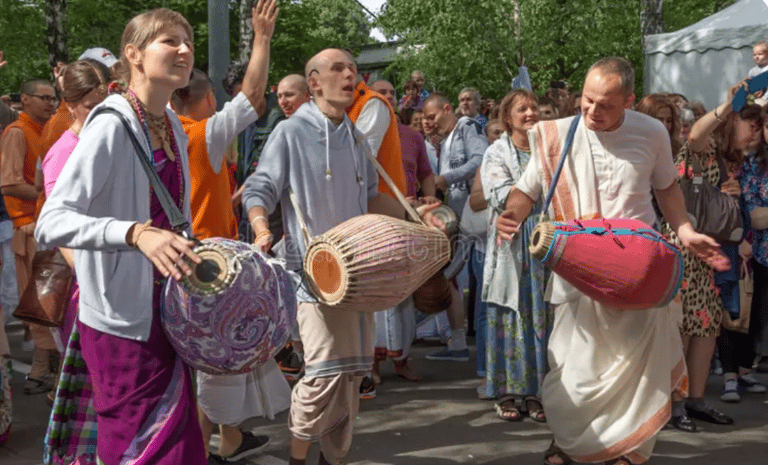
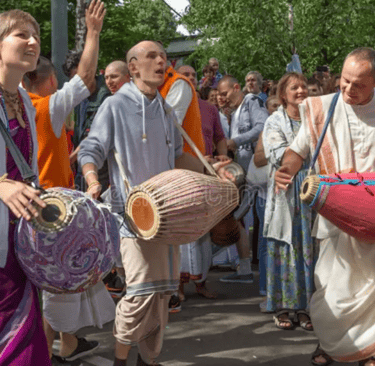
Several years ago, I happened to be part of a Sankirtan party, in Palo Alto, CA, USA. Our group was about 20 members, all working professionals in silicon valley but on this particular occasion we were not in our regular day jobs; rather we were volunteers dressed in traditional Indian clothing assembled in a public square performing Sankirtan -- a form of group singing, dancing and traditional Indian devotional music -- like shown in the picture here. You might have seen Sankirtan parties yourself in a place near you. Its amazing. Anyhow, for this particular day, our objective was to engage with the public, canvassing for our local ISKCON temple -- inviting them to join us, in our singing, musical dancing and having delicious vegetarian Prasadam -- all free of cost. I was handing out of our booklets and publications to passersby hoping to catch their attention and sparking a conversation. The method was very simple-- make eye contact, smile and greet with a quick, "Hello, How are you doing? Would you like to learn Yoga?"
And if they showed any interest, especially after hearing the word "Yoga" it was my plug -- to start a conversation and do the canvassing. The method was simple but effective. Often we would have several interested people -- attracted by the nice exotic music, happy faces, ecstatic dancing and of course the good food. They had never seen anything like this before. Some would stop and watch for a bit, some would clap, some not so shy ones would even happily sing and dance with us. I was told that many new members to our temple were introduced in this manner, through the monthly Sankirtan event. On this particular day, I remember seeing this beautiful young woman, probably in early 30s approaching our Sankirtan. Riding high with hopes of having a conversation with her, I greeted her with my usual oneliner; In response, she turned her head to look at me and replied nonchalantly "No. Thank you. I already know and practice Yoga!" and then she walked away. The exchange was brief, over in less than 5 seconds but it left a mark in my memory. I have often thought about this incident since then.
"No. Thank you. I already know and practice Yoga!" It was stated with confidence and poise.
What a Bummer! But not a surprise though -- since thats probably the case with 90% of the people. They mistake the entire Yoga system to be limited to just physical exercises (Yoga Asana) -- some exotic oriental physical art form alone. In my experience of the west, I have often seen Yoga studios called "Hot Yoga", "Cindy Yoga", "Nidra Yoga" and what not. But they all miss the point. And its not their fault entirely. Only partially. First of all, those who are interested only in their physical well being and pursue Yoga to that end, gravitate towards such exotic names. Unfortunately, most people are like that. That said, the bigger reason for such misconceptions prevalent about Yoga is due to the lack of authentic Yoga training by authentic teachers. What the world really needs is a flood of authentic Yoga teachers who will prepare and train the masses about what Yoga really is. Not the bogus "I know Yoga" types. But then again, its a demand supply problem -- what the market wants, the sellers sell.
So what exactly is Yoga then?
Well, thats what we are trying to clear here. Problem is, Yoga is a loaded word -- It is a lifetime work. But for sake of brevity here is a quick snapshot:
Yoga is a Sanskrit word that literally means "Union". The goal of Yoga is to pursue Dharma; as we saw earlier, Dharma is the eternal quality of the spirit to seek liberation from matter -- so then, Yoga is the process by which Dharma is achieved -- by harmonizing ones entire existence -- the physical body, the mind and the spirit to achieve one goal -- Liberation. This is the "Union" that the word Yoga means. Physical well being (or Yoga asanas) is but a minor part of that process.
If one is serious about learning Yoga, then one has to learn it directly from the source, Lord Sri Krishna, who is also called Yogeshwar or the Lord of Yoga. There is no higher authority on Dharma and Yoga than Lord Sri Krishna. The Bhagavad Gita is the direct word of the Lord and it describes Dharma and Yoga in detail. So any serious seeker of Dharma through the process of Yoga must base their quest on Bhagavad Gita, under the tutelage of a bonafide Yoga Guru who in turn himself learnt it in the same way. This is called Disciplic succession or Parampara in Sanskrit. Ours here is a humble attempt dedicated to Dharma, through Study and Practice of Yoga, as described in Bhagavad Gita.
"No. Thank you. I already know and practice Yoga!"
Yoga - Q&A
What is the relation between Dharma and Yoga?
If Dharma is the WHAT, then Yoga is the HOW.
According to Vedic tradition, Dharma of a spirit is to seek permanent relief from the repeated cycles of birth-death-oldage-disease. Dharma is pursued by the process of Yoga. Dharma and Yoga are described by Lord Krishna in Bhagavad Gita.
What is the importance of Lord Sri Krishna on the subject of Yoga?
In the Vedic tradition, Lord Sri Krishna also known as Jagannath (the Lord of the Universe) is accepted as the final authority on Yoga.
There is no higher authority than Jagannath on the subject of Yoga.
This is why He is also known as Yogeshwar - the Lord of Yoga.
What is the end goal of Yoga?
Yoga is the Process by which Dharma is pursued.
Dharma is the pursuit of Freedom from material existence. In various traditions, this is called by various terms like Moksha, Mukti, Nirvana, Liberation (from matter). This is the same as attainment of God or ones spiritual realization
The end goal of Yoga is Perfection in Dharma.
What is the importance of Bhagavad Gita on the subject of Yoga?
In the Vedic tradition, Lord Sri Krishna also known as Jagannath (the Lord of the Universe) is accepted as the final authority on Yoga.
There is no higher authority than Jagannath on the subject of Yoga.
This is why He is also known as Yogeshwar - the Lord of Yoga.
His direct word to His disciple Arjuna on the battlefield of Kurukshetra is documented as Bhagavad Gita. Thus, Bhagavad Gita is accepted as the authoritative text on Yoga.
What is the authoritative guide on Yoga?
In the Vedic tradition, Lord Sri Krishna also known as Jagannath (the Lord of the Universe) is accepted as the final authority on Yoga and Bhagavad Gita (His direct word) as the authoritative guide on Yoga.
According to Bhagavad Gita which is the highest Yoga path?
According to Bhagavad Gita, all Yoga paths eventually enable the spirit soul to pursue and realize its Dharma (to seek liberation from matter leading to God realization). That said not every Yoga path is equally placed with others. Some are more suited and practical depending on ones position in the matrix of Vedic Varnashrama Dharma. The highest Yoga path (dearest to Jagannath and hence getting His immediate attention and mercy) is the Bhakti Yoga (Love expressed as devotional service to please God) path. The Lord states this in several places in the Bhagavad Gita.
Is Yoga a science or art or both?
Science is the search for Truth. Pursuit of science requires a methodical, unbiased study. Truth is what remains unchanged over time and place.
Art is the goal of science; meaning when science approaches Truth, it becomes elegant and beautiful. Yoga fulfills all these conditions.
What are the various Yoga paths described in Bhagavad Gita?
Bhagavad Gita describes several Yoga paths (or methods) to attain Dharma. Depending on ones position in the matrix of Vedic Varnashrama Dharma, one may leverage one or more of the Yoga paths to pursue their Dharma. The Yoga paths described are -- Sankhya Yoga (analysis of prakriti and purusha - nature and enjoyer), Buddhi Yoga (intellectual reasoning), Jnana Yoga (philosophical analysis), Dhyana Yoga (meditation), Karma Yoga (perfection in work as service to please God) and Bhakti Yoga (Love expressed as devotional service to please God)
What are some common misconceptions about Yoga?
There are several misconceptions prevalent about Yoga. The cause of such misconceptions is incorrect / insufficient knowledge acquired from un-authoritative sources. Our goal here is to dispel them through our study, practice and work.
Here are top 5 misconceptions about Yoga. If you know of more, write to us and we will include them in here.
1- Yoga means physical exercises to attain good physical health.
No. Yoga is not just a physical exercise system. Yoga is a complete system which has many sub-systems, one of which is Yoga-asana (physical exercises). The end goal of Yoga is the pursue Dharma which is the pursuit of Freedom from material existence.
The rule of thumb is if a system is stated by Yogeshwar Sri Krishna (Lord of Yoga) in Bhagavad Gita, it is Yoga, otherwise it is not.
People who pose as Yoga Gurus and downgrade Yoga to just Yoga-asanas are imposters.
2- Since Yoga originated in India, Yoga is only meant for Indians.
No. Yoga is a scientific process -- a search for Truth in a methodical, unbiased manner.
It may have originated in India, but it is universal and a gift for all humanity, not just India or Indians. Though, it is naturally expected that Indians would study and practice it seriously as part of their culture. Unfortunately, this has not been the case in recent times mainly due to erosion of Vedic culture due to foreign invasions and colonization.
3- Yoga is a Hindu system. Practicing it means accepting Hinduism.
No. Yoga has nothing do with the Hindu faith. There is no mention of Hindu in Bhagavad Gita. Yoga is a means to attain Dharma. People confuse faith with Dharma.
Dharma is the eternal pursuit of the spirit to seek Freedom from matter (the cycle of birth-death-oldage-disease). It never changes.
Faith is a belief system which can change based on time, place, circumstance.
4- Isn't Patanjali Yoga sutra is the original Yoga?
The Sanskrit word sutra means one of these -- a thread, a formula, a theory or process.
The Patanjali Yoga sutra is a system of Yoga complied by Vedic sage Patanjali. It is a system of rules and regulations for pursuing Yoga but it did not change the meaning of Yoga itself (process to pursue Dharma).
Sage Patanjali is dated to about 2000 years ago while Sage Ved Vyas (who documented Bhagavad Gita -- the authoritative text on Yoga) is dated to about 5000 years ago.
5- Yoga is only to be learnt from Indian teachers?
Yoga is a complete system which has many branches. The end goal of Yoga is Dharma.
The authoritative text on Yoga is Bhagavad Gita. To study and practice Bhagavad Gita, one must follow the process which is stated in the Bhagavad Gita itself -- 1) a sincere student must approach a qualified Guru (one who follows Parampara system (disciplic succession) himself and imparts knowledge as is without any new interpretation from his side) 2) the student must serve the Guru respectfully and ask intelligent, inquisitive questions to know the Truth in a submissive manner (not argumentative, confrontational approach).
So if anyone has these qualifications, he/she can be accepted as a Yoga Guru.
What is the best place to learn and practice Yoga?
Sri Krishna imparted Bhagavad Gita -- the authoritative text on Dharma and Yoga -- to Arjuna in the middle of a battlefield. So there is no right or wrong place. But then again we are talking about Yogeshwar Sri Krishna -- The Lord of Yoga and Arjuna, the greatest military general of his time.
That said, practically speaking, for the most of us, a place that is clean, peaceful and pleasing to the senses is a good start. The recommended approach is to study and practice Yoga from a qualified Guru, in disciplic succession.
How to identify a qualified Yoga Guru?
Yoga is a complete system which has many branches. The end goal of Yoga is Dharma.
The authoritative text on Yoga is Bhagavad Gita. To study and practice Bhagavad Gita, one must follow the process which is stated in the Bhagavad Gita itself -- 1) a sincere student must approach a qualified Guru (one who follows Parampara system (disciplic succession) himself and imparts knowledge as is without any new interpretation from his side) 2) the student must serve the Guru respectfully and ask intelligent, inquisitive questions to know the Truth in a submissive manner (not argumentative, confrontational approach).
So if anyone has these qualifications, he/she can be accepted as a Yoga Guru.
I have a copy of Bhagavad Gita -- Can I self teach myself on Yoga?
This is a risky approach for most people.
Just having a Bhagavad Gita book and reading and interpreting it yourself is like trying to look up the chemical formula for a medicine online and trying to make it yourself in your kitchen. Risky approach. Not recommended.
To study and practice Bhagavad Gita, one must follow the process which is stated in the Bhagavad Gita itself -- 1) a sincere student must approach a qualified Guru (one who follows Parampara system (disciplic succession) himself and imparts knowledge as is without any new interpretation from his side) 2) the student must serve the Guru respectfully and ask intelligent, inquisitive questions to know the Truth in a submissive manner (not argumentative, confrontational approach).
So if anyone has these qualifications, he/she can be accepted as a Yoga Guru.
I have looked for a Yoga Guru for a long time but still cannot find one. What should I do? Is mine a hopeless case?
The best approach is not to rush. Start with self study. Pick up a Bhagavad Gita text from a publication that subscribes to the Parampara system (disciplic succession). Go slow, pay attention to each word in the text, make notes, write down questions, ask questions to others and observe their answers. Repeat. Yoga is a lifelong process. Be patient and submit to Jagannath. He will send help. He promises so in Bhagavad Gita.
What is Yoga?
Yoga is a Sanskrit word that literally means "Union".
Dharma is another Sanskrit word that means the eternal quality of the spirit to seek liberation from matter (ie liberation of repeated cycles of birth-death-oldage-disease) Yoga is the method to pursue Dharma by harmonizing ones entire existence -- the physical body, the mind and the spirit to achieve this goal -- Liberation. This harmony is the "Union" that the word Yoga means.
Go within