
Bhagavad Gita Introduction at Jyoti Sar, Kurukshetra -- the place where Gita was delivered
Bhagavad Gita
Srimad Bhagavad Gita - Vedic wisdom summarized
Verse of the Day:
अपि चेदसि पापेभ्यः सर्वेभ्यः पापकृत्तमः । सर्वं ज्ञानप्लवेनैव वृजिनं सन्तरिष्यसि ॥ ४.३६ ॥
Transliteration: api ced asi pāpebhyaḥ sarvebhyaḥ pāpa-kṛt-tamaḥ. sarvaṁ jñāna-plavenaiva vṛjinaṁ santariṣyasi
Translation: Even if you are the lowest sinner, by this boat of knowledge, you will cross over the ocean of material miseries
Meaning:
In this verse, Lord Krishna is assuring Arjuna, that the boat of spiritual knowledge is the greatest savior we have.
This material world is full of miseries. We make plans, desiring some results, we work hard, and things either go against our plans or things themselves are impermanent -- meant to be lost eventually. Net result, we dont have any permanent peace. For temporary fleeting time, we may think we are happy but it is not so. Because the cardinal truth about material existence is that it is by definition impermanent. It will be over sooner or later. So trying to derive permanence out of impermanence is a mirage -- never to be satisfied.
The only hope is to one that never fails us, one that is eternal -- the spirit and the spiritual knowledge. So the Lord is inducing us to not exhaust ourselves chasing an impossibility (permanent peace in an impermanent material world), rather to come to the understanding forthwith that the real solution is in seeking spiritual knowledge.
At the same time, the Lord is assuring us, that even if we are the lowest sinner, having committed numerous karma, sins, mistakes in the past, but having realized our mistakes, have hope. The hope is that now that we understood our mistakes, if we pursue sincerely the light of spiritual knowledge, that will absolve us of all our past karma, sins and mistakes -- however grave -- and carry us across across the miserable material existence. Guaranteed. This is a great hope for the whole world. There is nothing higher than the assurance of the Lord Himself.
[ Bhagavad Gita, Chapter 4, verse 36 ]
Bhagavad Gita - Q&A
What is the authoritative guide on Dharma?
In the Vedic tradition, Lord Sri Krishna also known as Jagannath (the Lord of the Universe) is accepted as the final authority on Dharma and Bhagavad Gita (His direct word) as the authoritative guide on Dharma.
What is the authoritative guide on Yoga?
In the Vedic tradition, Lord Sri Krishna also known as Jagannath (the Lord of the Universe) is accepted as the final authority on Yoga and Bhagavad Gita (His direct word) as the authoritative guide on Yoga.
What is the relation between Dharma and Yoga?
If Dharma is the WHAT, then Yoga is the HOW.
According to Vedic tradition, Dharma of a spirit is to seek permanent relief from the repeated cycles of birth-death-oldage-disease. Dharma is pursued by the process of Yoga. Dharma and Yoga are described by Lord Krishna in Bhagavad Gita.
Can you give examples of how we "engage our senses" to please Jagannath?
Sure. Here are some examples.
As living creatures, we have a body to maintain by food.
If we prepare foods that are recommended in Bhagavad Gita, offer them FIRST to Jagannath and THEN consume that food ourselves, we offered our sense of taste to Jagannath.
If we engage our speech in glorifying the Lord, we offered our speech.
Similarly, we have the sense of sight (eyes), sense of smell (nose) and sense of hearing (ears). If we surround ourselves with pictures of Jagannath, items that were offered to Jagannath (like flowers or incense) and devotional music glorifying Jagannath, then we offered our senses of sight, smell and hearing to Him. In this way, if we constantly think of Jagannath while carrying out our occupational duties (whatever it may be), we have offered our mind to Jagannath.
Jagannath Krishna directs in Bhagavad Gita, what can be offered to Him and how to please Him. We simply have to follow those instructions, and engage our senses.
What is meant by sense-gratification?
Sense gratification means considering the primary purpose of our existence as our own enjoyment through the body and senses -- eating, sleeping, mating -- and fighting anyone/anything that obstructs these activities.
Creatures with lower level of intelligence are entirely focused on this.
Humans with their higher intelligence are supposed to rise above this.
When a human tries to go beyond sense-gratification, Dharma begins.
What is the Dharma of the spirit?
According to Vedic tradition, Dharma of a spirit is to seek permanent relief from the repeated cycles of birth-death-oldage-disease. Dharma is pursued by the process of Yoga. Dharma and Yoga are described by Lord Krishna in Bhagavad Gita.
Why does the spirit get trapped in material world?
The spirit gets trapped in the material world due to its Karma. More specifically due to the "attachment" to the results of its Karma. This is because they want to enjoy matter -- eat, sleep, mate, fight and depending on their Karma, God grants them a certain body. Only in the human form, is it possible to break this cycle.
Why Human birth is precious?
Human birth is precious because only in human birth can the spirit pursue Dharma by practice of Yoga. Animals cannot do that. Only humans have developed enough intelligence and consciousness to think beyond self sense gratification (ie to live life beyond just eat sleep mate fight). Only when this happens can the spirit soul have any possibility of understanding their constitutional position in the cosmic manifestation .
Why is the material world considered a suffering?
According to Vedic tradition, material world means when a spirit soul takes on a body in one of the millions of species of life through the process known as birth. The body it gets depends on its 1) own desire (at last death) 2) past Karma 3) approval of God. Once born, the body is forced to grow old, face diseases and eventually die.
The body being temporary any effort to keep it young, strong, beautiful forever is futile. Yet the unwise, keeps trying to do so. This constant trying and failing is ever-frustrating and unpleasant. This is suffering.
What is the relation between Karma and Yoga?
Karma is Action. Action does not mean only physical action. Even thoughts and words are actions.
Yoga is the means by which Dharma is pursued.
Any Karma that is practiced as a Yoga to attain Dharma leads to Mukti or liberation from material world. Infact it is the recommended process and is described in detail in Bhagavad Gita by Lord Krishna.
Is sense gratification a bad thing?
Short answer:
No. Sense gratification is not a bad thing if we understand, "whose" senses are to be gratified.
Long answer:
According to Vedic tradition, Jagannath -- the Lord of the Universe -- the creator, the maintainer and annihilator is the Supreme enjoyer.
He is the original, oldest spirit from whom this entire Universe emerged, by His own desire, for His own pleasure. We are also spirit but we are neither the original nor the oldest spirits. We emerged from Jagannath at the start of creation and at time of annihilation we will return to Him.
Out of illusion (Maya), if we forget this fact and think that we are the supreme, that there is no God and the whole Universe exists for our pleasure then we make a fatal mistake -- we get bound by Karma and locked in an endless cycle of birth-death-oldage-disease.
On the other hand, if through pursuit of Dharma, we come to understand that the Supreme authority and Supreme enjoyer is Jagannath and our duty is simply to serve and please Him through our thoughts, words, actions, then we are not bound by Karma nor do we get caught in cycle of birth death oldage disease. In other words, we can live in the material world and carry on our activities as usual, as long as we "offer" them to please Jagannath. This is the core idea of Bhagavad Gita.
How do we "engage our senses" to please Jagannath?
"Engaging our senses" to please Jagannath means accepting Him as the Supreme enjoyer and performing all our Karma (ie actions through our body, mind and intelligence) to please Him. The secret is that by pleasing Him, we automatically become pleased. The simplest method of doing so is to sincerely perform our prescribed duties (Karma) according to our Vedic Varnashrama Dharma, as directed by Sri Krishna in Bhagavad Gita.
What is the ultimate message of Bhagavad Gita?
The ultimate message of Bhagavad Gita is that Jagannath is Lord of the Universe, its Supreme controller, its Supreme enjoyer. If we, the finite spirit souls, acknowledge His supremacy and try to please Him by pursuing our Dharma through the method of Yoga, as instructed and described by Him in Bhagavad Gita, then we are guaranteed His protection -- Freedom from Maya, Freedom from Karma, Freedom from all sufferings of the material world. Forever. The quickest way to achieve this is thro' Bhakti Yoga.
This Guarantee of His protection is the Ultimate Peace. Theres nothing higher than this.
What is the material world vs spiritual world?
Material world means when a spirit soul takes on a body in one of the millions of species of life through the process known as birth. Birth is forced on the spirit depending on the combined effect of 1) its own desire to "enjoy" material world especially at time of death 2) its own past Karma and 3) approval of God (of #1 + #2)
Spiritual world means when our spirit soul remains in its original spiritual condition and is not forced to be born in a new body because it 1) does not have any desire to "enjoy" matter and 2) it does not have any past Karma (that it must suffer or enjoy).
What is Karma?
Karma is Action. Action does not mean only physical action. Even thoughts and words are actions. Karma is a quality of the spirit soul. Every Karma has a reaction (when it is directed to "enjoy" matter for self sense gratification). But if the Karma is directed to "please" Jagannath (by practicing Yoga to pursue Dharma) then there is no reaction. As long as there is any Karmic reaction left the spirit is forced to take birth in the material world by the order of God.
How does Bhagavad Gita describe the Cosmic manifestation?
According to Bhagavad Gita, the Cosmic manifestation is an unending cyclic process comprising of repeated creation, maintenance, annihilation of the Universe at the will of the Supreme original spirit Jagannath. The name Jagannath literally means the "Lord of the Universe". Creation of the Universe means infinite matter, infinite spirit souls and infinite Time appear spontaneously from within Jagannath. Annihilation of the Universe means everything collapses back into Jagannath. Before and After creation, there is no matter, no soul, no Time -- only Jagannath. During the existence of the Universe, Jagannath AND the Universe exist simultaneously. The cosmic manifestation of Universe exists for the pleasure of Jagannath. Every finite spirit soul in the Universe is subordinate to Jagannath and their function is to accept His supremacy and try to please Him by following Dharma through the path of Yoga, When the spirit souls do so, they are Guaranteed Freedom from material world by Jagannath. But when the spirit souls under the influence of Maya, refuse His supremacy and try to please themselves instead, they get caught in Karma and are forced to repeat the cycle of birth-death-oldage-disease in various species of life.
Inconceivable as it may sound, its like the concept of infinity.
Infinite + Infinite = Infinite. Infiinte - Infinite = Infinite.
What is the relative position of the spirit in the Cosmic manifestation?
The function of the spirit soul is to understand its subordinate position relative to Jagannath and try to please Him by following Dharma through the path of Yoga, When the spirit soul does so, it is Guaranteed Freedom from material world by Jagannath.
What is the Historical context of Bhagavad Gita?
Bhagavad Gita is a dialog between Lord Sri Krishna and the great Pandava warrior Arujna, just before the onset of the Mahabharat war, in the middle of the battlefield, 5000 thousand years ago.
The place where this dialog took place is now known as Jyoti Sar (or Jyotisar) in Kurukshetra, India.
What is the relation between Mahabharata and Bhagavad Gita?
Bhagavad Gita is a dialog between Lord Sri Krishna and the great Pandava warrior Arujna, that appears in the Bhishma Parva section of the Vedic historical epic called Mahabharata, that was compiled by the great Vedic Sage Ved Vyas.
These Historical events occurred 5000 years ago in Northern India.
What is the status of Bhagavad Gita in Vedic civilization?
According to Vedic tradition, Bhagavad Gita is the direct word of God.
As such it is highly revered and through the ages, it has guided India's civilization and countless people. It is regarded as the crown jewel and summary of all Vedic knowledge.
What is the correct method of studying Bhagavad Gita?
The correct method of studying Bhagavad Gita is described in the Bhagavad Gita itself. A sincere student must approach a qualified Guru and learn it from him.
A qualified Guru is one who follows the disciplic succession or Parampara system. He himself learnt it from another qualified Guru. Such a Guru imparts knowledge as is without any new interpretation from his side. A sincere student is one who serves the Guru respectfully and asks intelligent, inquisitive questions to know the Truth in a submissive manner (not argumentative, confrontational approach).
Is Bhagavad Gita Sruti, Smriti or Itihas?
Sruti is the direct word of God passed down through generations of teachers and students via the parampara system (disciplic succession).
Smriti is social rules and customs specific to a particular time and place.
Itihas is Historical texts.
Mahabharata is a Historical text documented by Sage Ved Vyas.
Bhagavad Gita is part of Mahabharata. So its a historical event.
However, Bhagavad Gita is the direct word of God, and this knowledge was passed down from the supreme teacher (Krishna) to His disciple (Arjuna) and then from there on successive generations have studied it in parampara system.
Thus Bhagavad Gita is naturally a Sruti. It may have been documented as part of an itihas but it is a Sruti by virtue of its being the direct word of God.
Bhagavad Gita -- why is it relevant today?
Bhagavad Gita has all the answers to all spiritual the questions a Truth seeking human can ask, so it is as relevant today as it was originally.
The Bhagavad Gita is the ultimate Gift to Humanity.
By the Study and Practice of Yoga as described in Bhagavad Gita, everyone will be a better version of themselves and the world will be a better place.
What is Bhagavad Gita's verdict on Karma?
According to Bhagavad Gita, we have only one right. -- the right to perform Karma. Karma is Action. Action is not just physical action -- even thoughts and words are action. We have no rights to plan for or claim any results. Results are not under our control. If we simply perform our Karma, results will be an automatic natural consequence.
If we have no control on results of our Karma then should we not have desires, dreams, goals, ambitions?
We can have desires, dreams, goals, ambitions etc whatever name you want to give it. But after that, we must work for it, ie perform Karma to the best of our abilities. And leave it at that. Results will come. Results are an automatic natural consequence of our Karma awarded to us by God. We need not worry about results. Where we make the mistake is that we have the lingering "attachment" to a certain desired result. This attachment is what causes problems -- if things go according to our desires, we become happy and if things do not go according to our desires, we become sad. This attachment causes us to remain bound in the material world. If we understand our Dharma and mould our Karma accordingly then we avoid getting attached. The simplest method of doing so is to sincerely perform our prescribed duties (Karma) according to our Vedic Varnashrama Dharma, as directed by Sri Krishna in Bhagavad Gita.
If we have no control on results of our Karma then how to know what is our Karma?
The Karma we must perform is determined by our Dharma -- especially our position in the matrix of Vedic Varnashrma Dharma. This is well described in Bhagavad Gita (and Vedic scriptures).
I worked hard for my goal but I didn't achieve it; another person achieved it without working hard like me. Why?
This is a common complaint. The opposite (though rare) is also true -- someone gets great results despite very little effort, and we wonder why. According to Bhagavad Gita, the results are not in our control. Only Karma is. Results are dependent on 1) our effort 2) our past Karma 3) approval by God. The mistake starts when we the spirit souls forget that we are eternal and not just existent in this body/birth alone. We have had countless past births and will continue to have until our Karmic effects are exhausted. We forget our Karma in the past births but God does not (thats why He is God and we are not). God sees the totality of our past and present Karma and decides what we deserve, not what we desire. What we get here is not just dependent on #1 (our effort) but also #2 (our past Karma). If we understand this fact, accept what we get and try to reduce further attachment (ie Karmic affects) then eventually we will be free from all past Karma. The simplest method of doing so is to sincerely perform our prescribed duties (Karma) according to our Vedic Varnashrama Dharma, as directed by Sri Krishna in Bhagavad Gita.
Can past Karma be changed?
The correct framing of the question is "Can results of past Karma be nullfied"?
The short answer is Yes.
By now we understand that every Karma has a reaction or result (good or bad). And we have to experience the results whether we want or not. Until we exhaust all our Karma, we will remain in the material world -- ie have repeated birth-death-oldage-disease in various species of life. This is the Law of Karma.
The simple usual method of exhausting our Karma is to sincerely perform our prescribed duties (Karma), to the best of our abilities, according to our Vedic Varnashrama Dharma, as directed by Sri Krishna in Bhagavad Gita. And eventually all past Karma will be exhausted. While doing so, we should be careful not to become attached to new results. Because attachment extends our Karmic results.
However the fastest method of exhausting our Karma is to surrender immediately and completely to the Lord and render Loving service only to please Him. This is called "Unalloyed Devotion" or "Ananya Bhakti". That is the highest perfection of the Vedic Varnashrama Dharma. A completely surrendered soul is Dearest to the Jagannath. And to such a soul, the Lord personally Guarantees immediate relief from all past Karma.
What is the Law of Karma?
Karma is Action. Action is not just physical action -- even thoughts and words are action. In the material world, every Karma has a reaction or result (good or bad). And we have to experience the results whether we want or not. Until we exhaust all our Karma, we will remain in the material world -- ie have repeated birth-death-oldage-disease in various species of life. This is the Law of Karma.
What are the various Yoga paths described in the Bhagavad Gita?
Bhagavad Gita describes several Yoga paths (or methods) to attain Dharma. Depending on ones position in the matrix of Vedic Varnashrama Dharma, one may leverage one or more of the Yoga paths to pursue their Dharma. The Yoga paths described are -- Sankhya Yoga (analysis of prakriti and purusha - nature and enjoyer), Buddhi Yoga (intellectual reasoning), Jnana Yoga (philosophical analysis), Dhyana Yoga (meditation), Karma Yoga (perfection in work as service to please God) and Bhakti Yoga (Love expressed as devotional service to please God)
According to Bhagavad Gita which is the highest Yoga path?
According to Bhagavad Gita, all Yoga paths eventually enable the spirit soul to pursue and realize its Dharma (to seek liberation from matter leading to God realization). That said not every Yoga path is equally placed with others. Some are more suited and practical depending on ones position in the matrix of Vedic Varnashrama Dharma. The highest Yoga path (dearest to Jagannath and hence getting His immediate attention and mercy) is the Bhakti Yoga (Love expressed as devotional service to please God) path. The Lord states this in several places in the Bhagavad Gita.
What is the essence of Bhakti Yoga?
The essence of Bhakti Yoga (Devotion as Yoga) is unconditional Love for Jagannath. It is the process of moulding ones life in such a way that in every thought, word and action, there is a direct Loving connection to Jagannath -- to please Him by pursuing Dharma as He directed in Bhagavad Gita. This means unbroken remembrance. respect, awe, reverence, Love and Devotion for Jagannath in every condition or position of life.
What is Bhagavad Gita?
Bhagavad Gita (also called Srimad Bhagavad Gita or simply Gita for short) is the summary of all Vedic wisdom. It is a universal guide book for anyone seeking spiritual knowledge. It is accepted as the authoritative text on Dharma and Yoga.
It is a dialog between Lord Sri Krishna and the great Pandava warrior Arujna, that took place in the middle of a battlefield (Kurukshetra in Northern India), just before the onset of the Mahabharata war.
It comprises 700 Sanskrit verses divided in 18 chapters and appears in the Bhishma Parva section of the Vedic historical epic called Mahabharata, that was documented by the great Vedic Sage Ved Vyas.
These Historical events occurred 5000 years ago in Northern India.
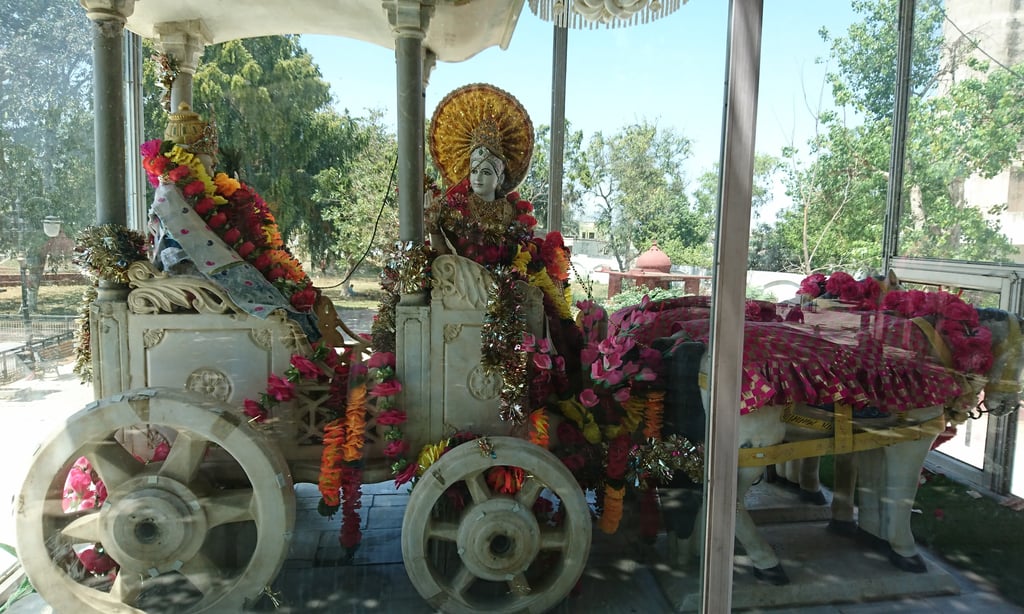
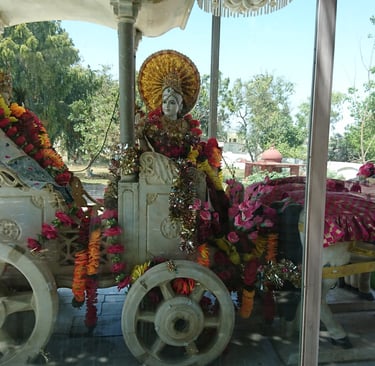
Jyoti Sar monument at Kurukshetra, India:
Jyoti Sar (or Jyotisar) is the place in Kurukshetra, India where the Bhagavad Gita was delivered by Lord Sri Krishna to the great Pandava warrior Arujna, just before the onset of the Mahabharat war, 5000 thousand years ago.
This is a real living place that still exists today and is one of the holiest places in Vedic civilization. Thousands of people visit it every year seeking spiritual enlightenment. I was fortunate enough to be one of them.
Bhagavad Gita is the summary of all Vedic Knowledge. It is composed of 18 chapters and a total of 700 verses. It appears as part of the Bhishma Parva of the great Vedic Epic called Mahabharata that was compiled (as a historical account of events that took place in Dvapar Yuga* about 5000 years ago in the Indian subcontinent) by Sage Ved Vyas. Being the direct word of the Lord Himself, Gita has answers to every question, that we face in our lives. As such it holds a supreme position in Vedic civilization. Over the ages, Gita has been the guiding beacon light of people all over the world -- especially India.
Bhagavad Gita is a textbook on Dharma and Yoga, delivered by the Lord of Yoga Himself -- Sri Krishna. According to Vedic wisdom, if one wants to achieve perfection of human life (Moksha or Liberation from matter), then Dharma is the goal and Yoga is the method of pursuing Dharma. A sincere lifelong study and practice of Bhagavad Gita under bonafide spiritual master in the Parampara system (Disciplic succession) is assured to deliver the us from this temporary and insatiable material existence to our eternal and real spiritual existence.