Dharma - the core of the Vedic Civilization of India
Dharma
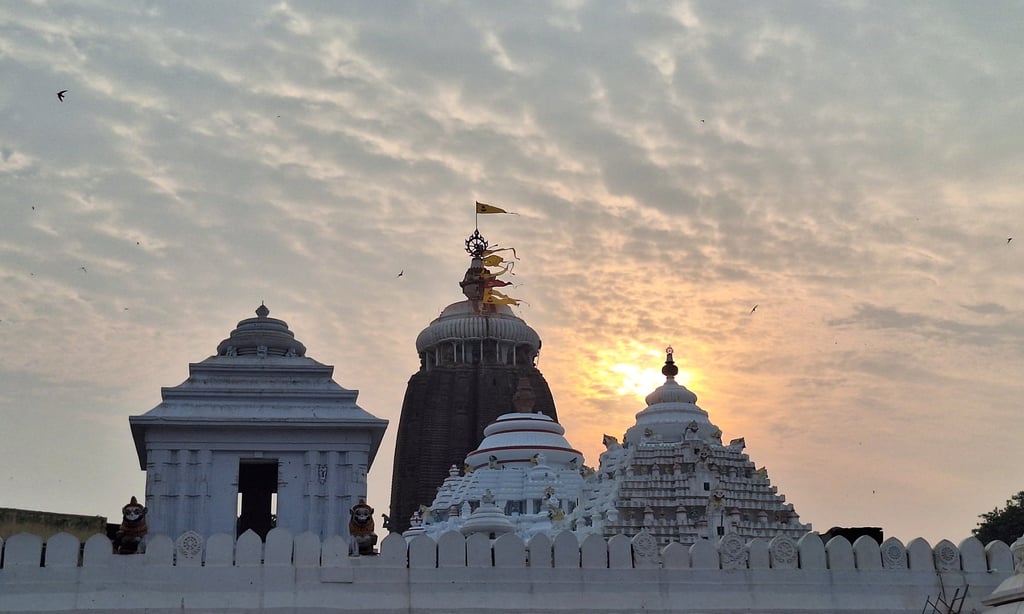
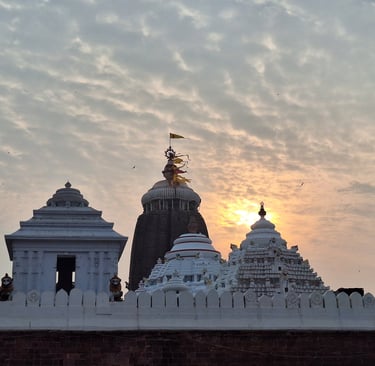
Lord Jagannath Temple, Puri
What is Dharma?
Is it Religion? Is it Faith? Is it Belief? Is it a Book? A building? A prophet? What is it?
Dharma is a Sanskrit word. Translating Dharma into English is difficult because there is not really a direct equivalent in English. If you consult the English dictionary, for the meaning of the word ‘Dharma’ you will probably find words like religion or faith. But that's an incorrect translation. Religion, faith, belief etc are all by nature temporary and dependent on time, place and circumstance. One may profess to religion X today under certain conditions but in some other time, place and condition they may change over to religion Y. That's not what Dharma is.
According to Vedic traditions, Dharma is the eternal quality of the spirit soul. The spirit soul is the indwelling entity that when present, a body (or creature) is considered alive, and when it is absent, the body is considered dead. Just like heat of fire is an ‘eternal quality’ of fire – inseparable and inherent, in the same way, Dharma is an eternal quality of the spirit – permanent, inseparable and inherent. One may ask what exactly is this quality? Well, according to Vedic traditions, Dharma of the spirit is to seek a state of permanent contentment and peace. In some Vedic texts, this state is described as Moksha or Nirvana or Mukti or in plain English – Liberation -- from the endless cycles of birth, death, old age and disease – life after life – in one species to the next. If we scrutinize deeper, we will note that Dharma is not the state of permanent peace itself – rather it's the pursuit of that state – it's the struggle, it's the endeavor. That is Dharma.
Dharma is also sometimes referred to as Sanatana Dharma. Sanatana being another Sanskrit word meaning Eternal. Since the spirit soul is eternal, its Dharma is also eternal and thus rightly called eternal Dharma or Sanatana Dharma.
Dharma is uniquely a human quality. Animals cannot do that. It requires a basic minimum level of intelligence that only humans possess. Human birth is a rare opportunity in the evolution of the spirit to find relief from the endless material cycle of birth, death, oldage and disease in various species of life. And to waste away this rare human birth without an effort to study and practice Dharma is indeed a pitiable waste that all intelligent persons must avoid.
Dharma - Q&A
Matter, Spirit and Consciousness -- What are they?
According to Vedic traditions, the cosmic manifestation of the Universe comprises of interplay of two entities -- matter and spirit.
Matter is the perceivable part of the Universe while Spirit is the imperceivable part.
Perceivable means it can be perceived by senses (eyes, nose, mouth, ear, touch).
This "interplay" happens under the direction of the Supreme Creator God, Lord of the Universe, Jagannath and when this happens, a living creature is born whereby sense perception becomes possible and the body is called "alive" or "conscious".
Both matter and spirit are eternal parts of Jagannath. Both are real.
Matter is called prakriti (nature), spirit is called atma, consciousness is called chetana.
What are the similarities and differences between matter and spirit?
Similarities:
1- Both matter and spirit are eternal.
2- Both are parts of Jagannath --both emerge from, exist in and dissolve into Jagannath.
3- Both are Jagannaths' potencies -- matter is Mahamaya while spirit is Yogamaya.
Differences:
1- Matter changes with Time. Spirit never changes with Time. Spirit is immutable.
2- Matter does not have consciousness. Spirit gives consciousness to matter.
3- Matter is considered inferior to Spirit -- because of above two reasons.
Note:
While both matter and spirit are eternal, only spirit is immutable.
Eternal and Immutable are two different things.
Eternal means lasting forever. Immutable means unchanging forever.
eg: an intact glass jar if left untouched will be eternal + immutable
the same glass jar when broken will still have the same atoms (eternal) but it is no longer a glass jar (it has changed, it has mutated).
Extending this idea to matter and spirit in the Universe:
When a spirit takes on one body at birth, it is the same immutable spirit that it was in another body in last life. Similarly when it takes another body in next birth, it will be the same immutable spirit.
While the individual body keeps changing (mutable) the spirit remains the same (eternal + immutable)
Yet the TOTAL matter of ALL the bodies combined in the Universe is constant (eternal)
All this happens at the will of Jagannath.
Who is Jagannath?
Jagannath is the name of God, in the Vedic tradition of India.
Jagannath, literally means the Lord of the Universe (in Sanskrit Language) -- the original, oldest Supreme spirit who creates the Universe, maintains it and eventually annihilates it. This is a cyclic process that goes on forever by the will of Jagannath.
Jagannath is also known as Sri Krishna, Vishnu, Narayana, Ram etc.
What is Maya, Mahamaya, Yogamaya?
These are Sanskrit words commonly found in Vedic literature.
Mahamaya and Yogamaya are complementary parts of Maya
Maya
Maya means Illusion literally.
It makes the individual spirit soul forget its eternal immutable spiritual state and get attached to the eternal but mutable matter. In doing so, it forgets Jagannath too.
Mahamaya
Mahamaya is that part of Maya that represents material nature
It binds spirit to matter by making it 'think' that matter is source of eternal Peace.
Yogamaya
Yogamaya is that part of Maya that represents spiritual nature
It hides the Supreme spirit (Jagannath) from individual spirit
Atma, Brahma, Jivatma, Paramatma, Bhagavan -- what are they?
All these words represent Spirits. These words are in Sanskrit language.
Atma, Brahma, Jivatma are different names for the spirit soul that takes a body at birth.
Paramatma is an instance (replica) of Bhagavan that accompanies the jivatma (as an observer and annotator of Karma) in the particular body that jivatma takes at birth.
Bhagavan is the original, oldest, unitary supreme spirit Jagannath who creates the Universe from within, maintains it and eventually annihilates it.
Describe the Cosmic manifestation.
According to Bhagavad Gita, the Cosmic manifestation is an unending cyclic process comprising of repeated creation, maintenance, annihilation of the Universe at the will of the Supreme original spirit Jagannath. The name Jagannath literally means the "Lord of the Universe". Creation of the Universe means infinite matter, infinite spirit souls and infinite Time appear spontaneously from within Jagannath. Annihilation of the Universe means everything collapses back into Jagannath. Before and After creation, there is no matter, no soul, no Time -- only Jagannath. During the existence of the Universe, Jagannath AND the Universe exist simultaneously. The cosmic manifestation of Universe exists for the pleasure of Jagannath. Every finite spirit soul in the Universe is subordinate to Jagannath and their function is to accept His supremacy and try to please Him by following Dharma through the path of Yoga, When the spirit souls do so, they are Guaranteed Freedom from material world by Jagannath. But when the spirit souls under the influence of Lords own illusory power Maya, refuse His supremacy and try to please themselves instead, they get caught in Karma and are forced to repeat the cycle of birth-death-oldage-disease in various species of life.
Inconceivable as it may sound, its like the concept of infinity.
Infinite + Infinite = Infinite. Infiinte - Infinite = Infinite.
Moksha, Nirvana, Mukti, Liberation -- what do they mean?
These are Sanskrit words often appearing in Vedic literature.
They all mean the same thing which is Freedom of the spirit soul from Maya.
When a spirit soul is free from Maya, it remembers is original state -- the eternal immutable spiritual state as constant companion of Jagannath.
What are Prakriti (nature), Purusha(spirit) and Guna (qualities)?
These are Sanskrit words often appearing in Vedic literature.
Prakriti means nature -- either material nature or spiritual nature.
Material nature represents the external physical world (matter)
Spiritual nature represents the internal spiritual world (mind, intel, habits)
Purusha means the spirit, the enjoyer or controller of prakriti. The equivalent english word is "person".
Guna means quality. There are 3 fundamental Gunas -- Sattva, Rajas and Tamas.
Sattva means goodness (Truth, kindness, cleanliness, spiritual enquiry etc)
Rajas means passion (desires, intensity, action, ambition etc)
Tamas means ignorance (laziness, lamentation, depression, malice, greed, lust etc)
The gunas combine in various degrees to produce prakriti.
So depending on its 1) desires 2) Karma and 3) Gods approval, a purush (spirit) gets a certain prakriti ie certain combination set of sattva+rajas+tamas. This prakriti then determines what external material nature (type of body) and internal spiritual nature (mind, intel, habits) this purush (spirit) will get at next birth.
Example:
If a spirit desires to be proficient in a certain field of activity (eg finance or money matters) AND it exerts its current body, mind, time, energy in that pursuit AND it has Gods approval (ie no past karma that could obstruct its desire) then at next birth, the spirit will get a material nature (body, family) and spiritual nature (mindset) that will be primarily Rajasic and less so Sattvic / Tamasic.
What is Vedic Varnashrma Dharma?
The Vedic Varnashrama Dharma was the foundational framework of the Vedic society.
It is described in Bhagavad Gita and other Vedic scriptures.
It can be understood as a matrix of two dimensions -- Personal life stages (Ashrama) and Professional Work (Varna).
The purpose of dividing one's life journey into personal & professional life stages was to progress from gross materialism to spiritual perfection in a systematic and balanced way. This is a practical application of the idea of practicing Yoga in pursuit of Dharma.
Ashrama:
Ones' personal life (Ashrama) is divided into 4 stages starting from birth:
1) Brahmacharya (celibate student life) 2) Grahastha (married life) 3) Vanaprastha (retirement to forest) 4) Sannyasa (celibate spiritual pursuit).
Varna:
One's Professional life (Varna) begins from youth (ie after Brahmacharya/student life) and it is more or less a lifelong pursuit. It is determined by one's Karma (action) which in turn is determined by their Gunas (qualities).
One's Varna could be one of these four:
1) Shudra (Labor service for salary) 2) Vaishya (Self employment in farming or trade)
3) Kshatriya (Governance/Politics) 4) Brahmana (Spiritual Teacher/Priest).
Note:
1) The Varna are based on one's Guna (Qualities) and Karma (Actions) ie purely on Merit not on Blood or Birth/Family heritage.
2) The purpose of Varnashrama Dharma is practical application of the idea of practicing Yoga in pursuit of Dharma.
2) In Vedic tradition, men were the leaders of family and society. Women were respected and protected by men. This provided a very stable and secure environment that is pre-requisite for a peaceful society. This also means that a woman followed the Varna and Ashrama of man. Until marriage the girl was under the care and protection of the father, after marriage the wife was under the care and protection of the husband, and after retirement/deceased husband the woman was under the care and protection of grown up sons.
Examples:
1) If a girl is married to a Vaishya man, she enters Grahastha ashrama in Vaishya Varna 2) A Kings daughter (Kshatriya Varna by birth) married to Brahmana man, means Grahastha ashrama in Brahmana varna (no longer Ksatriya -- birth family).
3) If a Kshatriya man retired to forest life (Vanaprastha) then the woman followed him.
In this way, Vedic Varnashrama system was designed for harmony, spiritual progress and peace. It is called a Dharma because it is an elegant and practical application of the idea of practicing Yoga in pursuit of Dharma.
What is Dharma?
Dharma is the eternal quality of the spirit soul to seek a state of permanent contentment and peace. The process by which this is achieved is called Yoga.
This state of permanent contentment and peace is called Moksha or Nirvana or Mukti or in plain English – Liberation -- from the endless cycles of birth, death, old age and disease – life after life – in one species to the next.
Isn't Dharma same as religion?
No, Dharma is an eternal unchanging quality of the spirit. Its a Vedic concept.
Religion on the other hand is a system of faith, belief or practice that can change with time, place or circumstance. It is more of a western concept. Usually it is associated with a book, building or prophet or any artificial/temporary symbol.
What is God? What does it mean? How do you define God?
The English word God translates to the Sanskrit word Bhagavan. In the Vedic tradition of India, Bhagavan denotes the original oldest unitary Supreme spirit -- one who creates, maintains, annihilates the cosmic manifestation of the Universe from within. Bhagavan is known by many names, the chief ones being Jagannath, Krishna, Narayana, Vishnu, Ram etc. In other sub-sects of the Vedic tradition (like Shakta) God is called differently like Siva (masculine energy) or Durga (feminine energy). In this text, we refer to Bhagavan by Jagannath or Krishna.
For the materially minded (like the material scientists), who want to define and understand God by empirical methods ie measurement of quantifiable metrics, God (Bhagavan) has been defined by Vedic sage Parashar Muni (father of sage Ved Vyas) as that supreme spirit who possesses SIX simultaneous and infinite properties -- Infinite strength, beauty, riches, fame, knowledge and renunciation. If someone can display these 6 infinite properties simultaneously, they are accepted as Bhagavan. Sri Krishna is documented to have displayed His infinite properties in His Universal form to Arjuna in the battlefield of Kurukshetra at the onset of the Mahabharata war. In addition, He displayed His infinity through His multitude of pastimes when He was physically present on earth in the Dvapar Yuga (age) over 5000 years ago. There are ample physical, literary and astronomical evidences for these pastimes in the shastras and can be verified by the empirically minded material scientists or seekers.
Is God male, female or neuter?
According to Vedic traditions, God or Bhagavan is the Supreme original oldest unitary spirit who creates, maintains, annihilates the cosmic manifestation from within. He does this out of His own free will. He is called Lord of the Universe, Jagannath.
We (living creatures) are also spirit souls but we are not the original nor the oldest souls like Jagannath. We appear from within Jagannath at creation, remain in the material world until it exists and return back to Him at dissolution. The commonality between Him and us that 1) we are both spirit souls and 2) we are both controllers and enjoyers of Prakriti (matter). The difference between Him and us is that He is infinite in His powers and we are finite. Because of this tendency to control and enjoy Prakriti, the spirit soul is also called Purusha. (Another name of Jagannath is Purushottam or Supreme Purusha).
In Sanskrit language, this "controlling or enjoying" quality of Purusha is ascribed to a masculine quality. That is why, the spirit soul Purusha is considered masculine, while matter Prakriti is considered feminine.
Note: This has got nothing to do with the body a particular Purusha (spirit soul) receives at birth. The body a particular Purusha receives at birth depends on 1) its desire at time of last death 2) its past Karma 3) Gods approval. Consequently, the body at birth may be a male body or female body but the quality of Purusha (spirit) is masculine, while Prakriti (matter) is feminine.
Is God personal or impersonal?
According to Vedic tradition and especially in Bhagavad Gita, it quite clearly stated that Jagannath is the father of creation -- the entire cosmic universe, material nature and all spirit souls present in living creatures. As such He is impartial or equal to every soul. He does not favor anyone over another. He doesnt need to because He is complete in Himself. That said, He states in several places that those spirit souls who are striving to follow Dharma, them He favors and takes care of personally.
In other words, if we show attraction and effort to please Jagannath, He is Personal.
Otherwise He is impartial by default and simply awards us the results of our Karma.
I am an atheist. Why should I care about Dharma or God?
You may be anything and have any qualities. It does not matter to God. God is complete in Himself. He does not need anything from you. God is God. If you follow the direction of God to pursue your Dharma through Yoga, it will benefit you. It will save you time and rebirth. And God will help you.
If on the other hand, if you dont feel the need of Dharma or God, it does not matter to God. He will not interfere, but you will be prolonging your entanglement in material world. The choice is yours, what do you want?
Hasnt religion caused more problems than any other human activity?
Religion may have, Dharma has not. We are not concerned with religion. We are concerened with Dharma. As stated above, religion is an english word denoting a system of faith, belief or practice that can change with time, place or circumstance. It is more of a western concept. Usually it is associated with a book, building or prophet or any artificial/temporary symbol. Obviously, temporary or localized ideas are bound to create friction and problems with those who dont follow the same principles.
In the Vedic tradition, the term and meaning of religion is not accepted. The term accepted in Vedic tradition is Dharma, an eternal unchanging quality of the spirit. It is a universal idea and hence it does not change with time, place, circumstance. Naturally, such a universal idea is acceptable to everyone and does not create disturbance.
Does Dharma automatically imply a creator God?
In the Vedic tradition, Dharma is an eternal quality or characteristic of the spirit soul.
It is the pursuit of the soul to seek freedom from cycles of birth-death-oldage-disease.
On the other hand, God or Bhagavan is the Supreme spirit soul -- the original oldest unitary soul who creates, maintains, annihilates the cosmic manifestation from within.
God is the father of Dharma. Dharma comes from God, not the other way around.
I have good morals, good habits, obey laws and pay my taxes. Do I still need God?
According to Vedic tradition, God is complete in Himself, He does not anything from us. Yet if we follow our Dharma and practice Yoga as He directed us in Bhagavad Gita, then He responds favorably by helping us execute our Dharma (which is to be free from matter ie the cycle of birth-death-oldage-disease)
On the other hand, if we want to forget Him, He lets us do that too. His agency of Maya helps us be more an more fixed in material pursuits.
Its in our own interest to approach God. Question is do we want Him?
What is the authoritative guide on Dharma?
According to Vedic tradition, Jagannath, the Lord of the Universe, the original oldest unitary Supreme spirit one who creates, maintains, annihilates the cosmic manifestation from within is the father of Dharma. The supreme authority. He is also known as Lord Sri Krishna.
His direct word, the Bhagavad Gita is accepted as the authoritative guide on Dharma.
What is the relation between Dharma and Yoga?
These are two Sanskrit words often appearing in Vedic literature.
If Dharma is the WHAT, then Yoga is the HOW.
According to Vedic tradition, Dharma of a spirit is to seek permanent relief from the repeated cycles of birth-death-oldage-disease. Dharma is pursued by the process of Yoga. Dharma and Yoga are described by Lord Krishna in Bhagavad Gita.
What is the importance of Lord Sri Krishna in the context of Dharma?
In the Vedic tradition, Lord Sri Krishna also known as Jagannath (the Lord of the Universe) is accepted as the final authority on Dharma and Bhagavad Gita (His direct word) as the authoritative guide on Dharma. He is considered the Father of Dharma.
What is the importance of Bhagavad Gita in the context of Dharma?
In the Vedic tradition, Lord Sri Krishna also known as Jagannath (the Lord of the Universe) is accepted as the final authority on Dharma and Bhagavad Gita (His direct word) as the authoritative guide on Dharma.
Why and How should we pursue Dharma?
The Dharma of the sprit soul is to seek liberation from matter. It does not matter if the spirit soul knows this or not. It will eventually have to realize this in this birth or in some future birth. If you (the spirit soul) follow the direction of God to pursue your Dharma through Yoga, it will benefit you. It will save you time and rebirth. And God will help you.
If on the other hand, if you dont feel the need of Dharma or God, it does not matter to God. He will not interfere, but you will be prolonging your entanglement in material world. The choice is yours, what do you want?
On how to pursue Dharma, the recommended path is through study and practice of Yoga, as described in Bhagavad Gita, under the guidance of a qualified Guru.
Who is a qualified Guru?
A qualified Guru is one who follows the disciplic succession or Parampara system. He himself learnt it from another qualified Guru. Such a Guru imparts knowledge as is without any new interpretation from his side. A sincere student is one who serves the Guru respectfully and asks intelligent, inquisitive questions to know the Truth in a submissive manner (not argumentative, confrontational approach).
What is Parampara -- the Disciplic Succession?
As we discussed earlier, the Knowledge of Dharma and Yoga came directly from Jagannath Krishna in the form of Bhagavad Gita. It was delivered directly to His disciple Arjuna and documented by Vedic sage Ved Vyas.
Thereafter, this knowledge has been passed down through generations of Guru (teachers) and Shishya (disciple). We already discussed the qualities of a qualified Guru and sincere disciple above. This tradition of Guru - Shishya passing down Knowledge from one generation to another without any changes/new interpretations to the knowledge itself is called Parampara or the Disciplic Succession.
What is the Gurukul system?
In the Vedic tradition, the system of education and knowledge was different from the we have today. In today's system, parents send their children to an educational institute (school, college, university), pay a tuition fees and in return the educational system awards the students a certificate, diploma or degree. Children usually reside with their parents at home and visit the school on daily basis. In rare cases, students may reside in some hostel or dorm while pursuing the education. Nevertheless, the concept is students pay tuition, educational institute awards a paper (degree/diploma). The more the money higher the quality or reputation of the paper -- usually.
The Vedic system was different. It was called the Gurukul system, which literally means the clan of the Guru (or House of the Guru). In this system, children (usually boys) at age 5 or so were sent away from home to reside fulltime with a qualified Guru for years until they completed their education and became qualified to accept the next stage of Vedic Varnashrama Dharma. (usually age 20). The place of the Guru was called an Ashram (literally means a hermitage) usually in the countryside in a more natural quite setting away from busy society or distractions. The idea was peace and quiet is conducive for pursuit of knowledge. So this meant about 15 years away from home. During this period, the children were completely under the care of the Guru. The Guru and his wife were highly revered by the students -- like own parents and guides. The students' only purpose was service to the Guru and pursuit of knowledge. If the Guru ordered any task, it was binding. There was complete abstinence from sexual activity. That is why this stage was called 'brahmacharya' (celibacy). Irrespective of the family background -- whether sons of poor brahmana, powerful king or wealthy father, the children were all expected to be at the same level and treated equally. The Guru did not charge a fee, it was completely free education in exchange of service around the Ashram that the disciples provided (like cleaning, farming, repairing etc). The education itself covered every field of knowledge -- physical sciences, spiritual sciences, philosophy, logic, arts, military skills, morality, scriptural studies etc. Because this was a fully residential system in the complete care of the Guru (away from birth family), such a system developed complete character (Truth, courage, self reliance, morality, humility, simplicity etc) and well-prepared the student for their next phase of life and profession in the matrix of Vedic Varnashrama Dharma. At the end of the student phase, there was no paper degrees but rather qualities and skills that were recognized as valuable asset to self, family and society. When people are trained like this from beginning, it lays the foundation for a just and peaceful society.
Note: One may ask was this system only designed for male students? If so what about girls? Does that mean that the girls were not educated or skilled?
In the Vedic tradition, girls were homeschooled and trained. They did not go away from home to pursue education and training. There have been many Rishikas (woman sages) in Vedic culture. Infact, several Vedic compilations are attributed to Rishikas.
The Gurukul system was primarily meant for male students. We should note that the Vedic society was very protective and caring of the women folk. This provided a very stable and secure environment that is pre-requisite for a peaceful society. Until marriage the girl was under the care and protection of the father, after marriage the wife was under the care and protection of the husband, and after retirement/deceased husband the woman was under the care and protection of grown up sons.
What is Grhasthashram, Grhavrta, Grhmedhi?
These are Vedic terms in Sanskrit language. The word Grh means home.
Grhastha means a person who is married and is actively pursuing Dharma through the process of Yoga. Grhasthashram is personal life stage of a Grhastha.
The primary goal of a Grhastha is spiritual realization and not sense gratification.
Grhavrta and Grhmedhi are interchangeable terms which simply mean married people who are more interested in material sense gratification than in spiritual realization.
Dharma, Sanatana Dharma, Vedic Varnashrma Dharma -- all same?
Dharma is the eternal quality of the spirit soul to seek a state of permanent contentment and peace. The process by which this is achieved is called Yoga.
The word Sanatana means eternal
Hence Dharma is interchangeable with the term Sanatana Dharma.
Vedic Varnashrama Dharma is the foundational framework of the Vedic society.
It is a practical application of the idea of practicing Yoga in pursuit of Dharma.
Are Sanatana Dharma and Hinduism the same thing?
Dharma is the original Vedic term for the spirit's eternal pursuit is to seek permanent relief from the repeated cycles of birth-death-oldage-disease. It appears multiple times in various Vedic texts especially Bhagavad Gita.
Dharma is interchangeable with the term Sanatana Dharma.
Hindu is a more recent terminology especially after 1000 AD when foreign influence in Indian subcontinent became more common. It was used by the foreigners to refer to people of India. Hinduism is an English term for the belief system and practices of Hindus. It is not a very accurate term for what Dharma represents. We prefer and recommend the original term Dharma or Sanatana Dharma.
Is Vedic Varnashrama Dharma relevant today?
The Vedic Varnashrama Dharma was the foundational framework of the Vedic society.
Its primary purpose was help a person progress from gross materialism to spiritual perfection in a systematic and balanced way. It is an elegant and practical application of the idea of practicing Yoga in pursuit of Dharma. As such is highly relevant today.
Our goal here is to spread this idea so that more people can understand the strong foundations of Vedic culture and adopt it. That is the most reliable way we know of creating a peaceful and harmonious world.
Isn't study of science better than pursuing Dharma?
Science is the search for Truth. Pursuit of science requires a methodical, unbiased study. Truth is what remains unchanged over time and place.
Generally when someone uses the word"science" they mean "material science".
That is an incomplete meaning because matter alone is insentient and without consciousness. There is a higher entity -- spirit -- that gives consciousness to matter.
So studying spirit is more important as well as higher than studying just material science. Dharma is the science of spirit and it is pursued by the method of Yoga.
What to do if there is a contradiction between religion and science?
As discussed above, religion is an english word which represents a faith, belief or practice that can change with time, place, circumstance. We are not concerned with religion. We are concerned with Dharma. Dharma is an eternal and unchanging Truth. Dharma is the science of spirit. This is very much like material science which tries to discover material Truths. We dont see contradiction between Dharma the spiritual science and material science as both are search for Truth. If anything, Dharma is a superset of material science.
Isn't nature worship better than going to a temple?
Generally, nature worship means material world -- rivers, trees, mountains, earth, etc.
That is fine for neophyte spiritualists who are more enamored by the impersonal features of cosmic Universe. More advanced spiritualists seek out for that what brings matter to life -- the spirit soul and that is what Vedic civilization emphasizes more. A temple in Vedic tradition is a place where devotees who have difficulty concentrating on impersonal spirit can see a personified expansion of the supreme spirit in the form of a deity. So its fine if someone begins with nature worship but eventually in time, this rises to higher concept of deity worship. At the final stage, one sees God everywhere not just in temple and that is the highest stage of devotion.
BTW, Vedic civilization is full of nature worship. Here trees, animals, rivers, mountains, earth, planets, moons, stars etc are all worshipped. It "sees" a Supreme spirit (God) acting behind each of these. Isnt that nature worship at its highest?
Isn't philantropy, social work and such better than donating to temples?
Philantropy, social work and material service is fine for the neophyte spiritualist who are unable to see the infinite spiritual energies of the supreme spirit Jagannath. At the highest level of spiritual realization, one goes beyond matter and idea of material well being alone. This is because material conditions are always changing and there is never going to be a time when material condition of everyone everywhere will be perfect. Instead concentrating on spiritual elevation and freedom from material suffering is a better proposition. Temples are a center for such activity in Vedic tradition. So encouraging them with our support is a higher level of spiritual activity. Of course we have to see that donations are properly allocated but thats the domain of Government.
What is the role of Shastra (scriptures) in Dharma?
In Vedic tradition, Shastra or scriptures are universally accepted as the code of Dharma handed down directly from Jagannath through the parampara system and validated by all the great acharyas (preceptors). So they are of central importance. However, the volume of scriptures is simply too much for most people to cover in one lifetime, that is why we concentrate on Bhagavad Gita which is the crown jewel and summary of all Vedic scriptures. In 700 verses in 18 chapters it covers everything we need.
What is the importance of rituals in Dharma?
Rituals, methods, ceremonies and such are helpful in pursuing Dharma especially if they are according to scriptural injunctions. Again Vedic traditions are very vast and knowing and following all rituals may not be very practical or possible in todays' age,
That is why we concentrate on Bhagavad Gita which is the crown jewel and summary of all Vedic scriptures. In 700 verses in 18 chapters it covers everything we need.
Sruti vs Smriti -- what is the difference?
In Vedic tradition, Sruti is the direct word of God passed down through generations of teachers and students via the parampara system (disciplic succession).
Smriti is social rules and customs specific to a particular time and place.
Itihas is Historical texts. Sruti is considered higher than Smriti and Itihas.
Bhagavad Gita being the direct word of Jagannath Krishna is accepted as a Sruti.
Is Sanskrit the key to unlocking Shastras?
Vedic scriptures or Shastras are almost entirely compiled in Sanskrit language. So a basic knowledge of Sanskrit is very helpful. However, in modern times there have been many great Acharyas (preceptors) who have taken the pains to broadcast the Shastric knowledge to the masses in other languages like English. One can start there and then gradually they can appreciate the beauty of Vedic Shastras. Bhagavad Gita is quite straightforward Sanskrit, which is very helpful for beginners to follow along.
Is Vedic knowledge only meant for India?
No. Not at all. Vedic scriptures may have their origins in India but they are universal in nature and thus any sincere student who genuinely wants to learn spiritual Truths, practice Yoga and pursue Dharma will benefit from them. Fortunately, there are many great Acharyas who have taken the pains to broadcast the Shastric knowledge to the masses in other languages like English.
Does being Dharmic mean, I have to renounce family, home, job, money etc?
No. Not at all. Quite the opposite. Sri Krishna imparted Bhagavad Gita -- the authoritative text on Dharma and Yoga -- to Arjuna in the middle of a battlefield.
Arjuna wanted to renounce everything and give up the idea of the fratricidal Dharmic war and Sri Krishna chastised him. The beauty of Bhagavad Gita is that it does not forbid Vedic Varnashrama Dharma rather it glorifies it by turning the object of all action from self sense gratification to pleasing the senses of Jagannath. Karma Yoga and Bhakti Yoga are meant for exactly that.
Does being Dharmic mean being vegetarian?
There are misconceptions about food and Dharma which need to by analyzed closely.
To be Dharmic means to pursue Dharma --ie pursuit of liberation from matter through process of Yoga. This implies that spirit soul is entangled in matter (thats why need for liberation from it). Why is spirit soul entangled in matter? It is due to Karma -- ie Karmic reaction. Why is there Karmic reaction? because it engages in self sense gratification instead of pleasing senses of Jagannath. One of the primary self sense gratifications is the sense of tongue. That is where topic of food/speech come from. If the sense of tongue is dictating violence -- either through pain inflicted on another living creature or through hurtful abusive speech -- for ones own sense (tongue) gratification is that not detrimental Karma -- ie producing a negative reaction? If you cause violence willfully, you will have to suffer the same in future by virtue of Law of Karma. So this is why causing pain / bleeding / death for sake of ones food is considered Tamasic (ignorant), producing bad Karmic effects and thereby obstructing ones spiritual progress or Dharma.
Note: Milk comes from bovine creatures. But it does not involve pain/bleeding/death. Hence it is acceptable. Similarly honey is acceptable.
One may ask -- isn't a plant a living creature -- so doesnt eating plants involve killing a plant? Well, yes, but the question is how sentient is a plant in comparison to a living creature -- does it cause pain/bleeding/death? Plants being lower in evolution compared to animals, they are not comparable -- just like killing a mosquito cannot be equated to killing a human. Lastly, in Bhagavd Gita, Jagannath Krishna Himself stated that He accepts leaf, flowers, fruit (ie plant based food) so that instruction is followed.
What are the qualities and prescribed duties of the four Ashramas?
In the Vedic tradition, ones personal life is divided into four stages:
1) Brahmacharya Ashram - Celibate student life from birth to Marriage. In this stage the primary focus is education, skill development, character building in a Gurukul. Celibacy is emphasized because it provides the necessary conditions for real knowledge seeking and spiritual development. This phase usually lasts between age 5 and 20. After this phase, the student is well equipped to pursue their next phase of personal and professional life.
2) Grhastha Ashram - Marriage and householder stage. After Brahmacharya, if one desires to have a marriage and family life, they can do so. Others can proceed straight to the final stage Sannyasa right after Brahmacharya although that is rare. In the Grhastha phase, a person is expected to pursue family life for spiritual development with the help of their spouse -- as a team. A good dharmic marriage is very helpful and peaceful setting for spiritual development. The goal is not self sense gratification but to follow the Dharmic injunctions of the Shastras (scriptures) as a service to God. Grhasthashram produces cultured children who grow up to be ideal citizens.
3) Vanaprastha Ashram - Once the children are grown up and able to take care of themselves, the Grhastha (usually between age 50-60), are advised to retire from married life and proceed to a retreat setting in nature (vana = forest, prastha = to go) away from society, in a hermitage in forest or countryside. The wife is advised to follow the husband to vanaprastha away from family. If the husband is deceased, she is supposed to be in the care and protection of her grown up sons. The goal of vanaprastha stage is to pursue Dharma through scriptural study and Yoga practice in a peaceful setting away from distractions of society and family. In this stage the spouses support each other in old age. Celibacy is again primary.
4) Sannyasa Ashram - This is the final stage of ones life. Everyone (irrespective of Varna or whether one was a Grhastha or not) is expected to reach Sannyasa stage. This is where one completely surrenders to the Lord and pursues Dharma. Bodily demands are kept to a minimum (eating, sleeping, grooming etc). Sexual activity is completely forbidden. The person renounces all family relationships and lives in isolation. If they have the opportunity, they may travel places and preach. The core idea is that through all this lifelong spiritual training one may reach the perfection of Yoga (in this very lifetime) and at the time of death be able to break the material entrapment for ever.
What are the qualities and prescribed duties of the four Varnas?
Note:
1- Professional life (Varna) starts at the end of Brahamacharya Ashram.
2- Professional life (Varna) is independent of personal life stages (Ashramas).
3- According to Bhagavad Gita, the Varna are based on one's Guna (Qualities) and Karma (Actions) ie purely on Merit not on Blood or Birth/Family heritage.
4- A person, through training and practice of Yoga, may be able to change their qualities and uplift themselves to the highest Varna (Brahmana) -- in this very lifetime or in next. 5- The ultimate goal is that one should eventually reach the highest Varna (Brahmana) and highest Ashrama (Sannyasa) and break the material entrapment for ever.
Now lets look at the Varnas and their characteristics..
In the Vedic tradition, ones Varna is classified as follows:
1) Shudra (Labor service for salary) 2) Vaishya (Self employment in farming or trade)
3) Kshatriya (Governance/Politics) 4) Brahmana (Spiritual Teacher/Priest).
Shudra:
Least intelligent. Dependent on others for livelihood, Provide Labor service for salary.
Prone to ignorance, fear, indecision, lamentation.
Vaishya:
Self employed in farming or trade (finance), Engaged in cow protection.
Usually expected to provide charity and support Brahmanas/Sannyasis.
Kshatriya:
Characterized by Courage, Strength, Nobility, Enterprise, Military readiness, Protection of weak, Punishment of Adharma.
Usually expected to provide charity and support Brahmanas/Sannyasis.
Engaged in Governance/politics.
Brahmana:
Peaceful, Sense controlled, Simple, Austere, Clean, Tolerant, Knowledge seeking, wise and Faithful to Dharma.
Usually engaged as Spiritual Teacher/Priest. Providing guidance to Kshatriyas and society. Dependent on Charity from Vaishyas and Kshatriyas for livelihood.
Main pursuit of life is Spiritual Knowledge not wealth nor sense gratification.
What is Karma?
Karma is Action. Action does not mean only physical action. Even thoughts and words are actions. Karma is a quality of the spirit soul. Every Karma has a reaction (when it is directed to "enjoy" matter for self sense gratification). But if the Karma is directed to "please" Jagannath (by practicing Yoga to pursue Dharma) then there is no reaction. As long as there is any Karmic reaction left the spirit is forced to take birth in the material world by the order of God.
What is the Law of Karma?
Karma is Action. Action is not just physical action -- even thoughts and words are action. In the material world, every Karma has a reaction or result (good or bad). And we have to experience the results whether we want or not. Until we exhaust all our Karma, we will remain in the material world -- ie have repeated birth-death-oldage-disease in various species of life. This is the Law of Karma.
How does Karma relate to Dharma?
According to Bhagavad Gita, ones Karma must align with Dharma. Ones Dharma can be determined by their position in the matrix of Vedic Varnashrama Dharma.
Which is higher and more relevant -- Dharma or Nationalism?
Dharma is an eternal immutable quality of the spirit soul -- to seek real freedom from matter. It never changes, and once perfection in Dharma is attained, there is no rebirth.
Nationalism -- the idea a certain land, country, faith is better than others because you are born in it. What is the guarantee that your next birth will not be in a different land, country, faith? What will you profess then?
All such "isms" are temporary material relationships. If Dharma is there, everything else will be fine. Not the other way around. Vedic tradition advises us to transcend "isms" and devote our human birth to pursuit of Dharma through Yoga. That is the verdict of Purushottam Jagannath Krishna. There is nothing higher than that.
What are your views on Sanatana Dharma vs Hinduism?
Most people are confused between these two terms. Especially in India where these two ideas originated. Sanatana Dharma or simply Dharma is an eternal immutable quality of the spirit soul -- to seek real freedom from matter. It never changes, and once perfection in Dharma is attained, there is no rebirth.
Hindu is a more recent terminology especially after 1000 AD when foreign influence in Indian subcontinent became more common. It was used by the foreigners to refer to people of India. Hinduism is an English term for the belief system and practices of Hindus. It is not a very accurate term for what Dharma represents. We prefer and recommend the original term Dharma or Sanatana Dharma.
See beyond